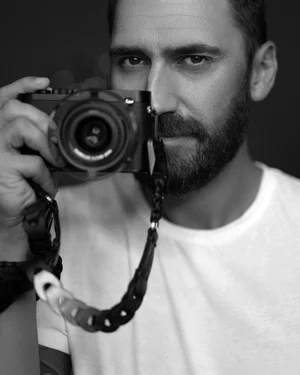
Portrait: Chiara Boschis
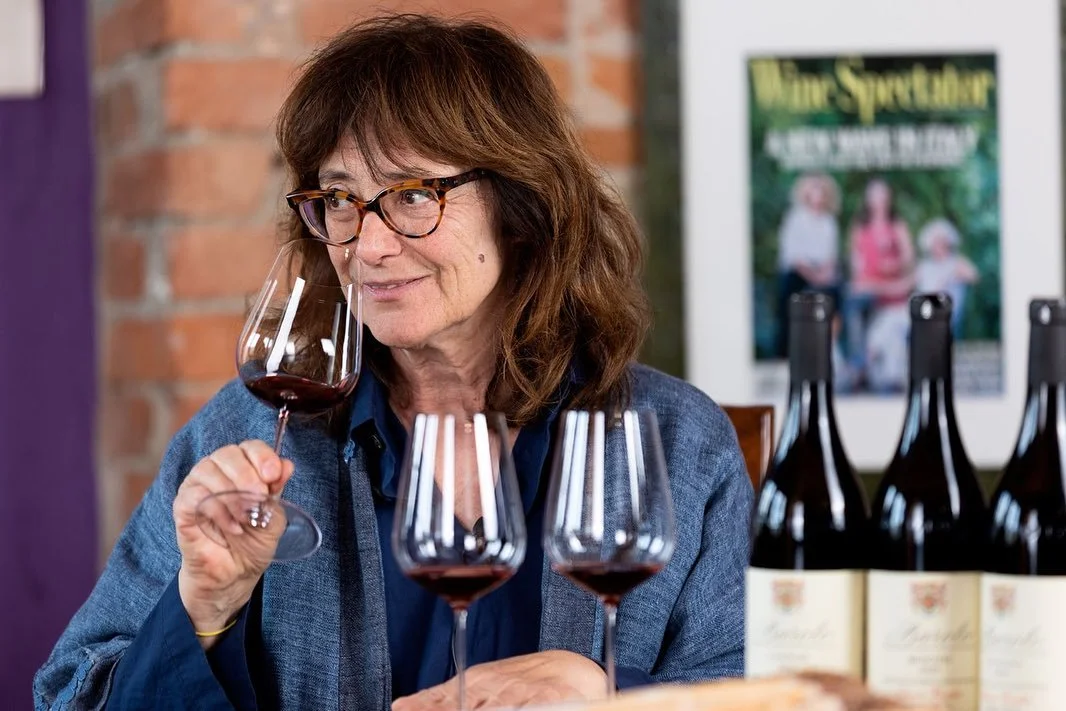
The Cannubi parcel is less than one hectare. Chiara Boschis has been farming it since 1990 and she will tell you, directly, that she wishes it were more.
The most celebrated cru in the Barolo denomination, farmed by her family for forty-five years, and the parcel is so small that the entire annual production fits inside roughly 300 cases. She knows every row. She navigates the powdery Tortonian soil, the sandy clay that makes each step uncertain on the steeper sections, the way someone navigates a place they have learned entirely through repetition. A visitor struggles. Chiara walks it without looking down.
This is the detail that matters. Not the scores, not the Tre Bicchieri, not the 98 from Wine Advocate — the fact that she has been walking that specific slope for thirty-five years and still farms it by hand, every operation, because the parcel and the gradient demand it and because she would not have it otherwise.
She retains the honour of being the first female winemaker in the Langhe. That fact carries a history that the title alone does not quite hold. In 1981, Chiara convinced her parents to take out a mortgage to purchase the E. Pira winery and its vineyards. She was in her early twenties. Her family's reputation was in Borgogno, the historic estate that her brothers were being prepared to run. The assumption was that she would follow a different path. She looked at the small estate at the edge of the village of Barolo — E. Pira e Figli, which had passed into difficulty after the death of Gigi Pira in 1980 — and decided that this was the path.
She studied economics in Turin. She worked at an international consulting firm to earn enough money to come back. Her family took care of production until 1990, when Chiara finally took over management. She was thirty. She had been preparing for twelve years.
The Barolo Boys were forming around that time — the group of young winemakers who decided that the old way of making Barolo was producing wines too tannic, too oxidised, too inaccessible for the market that was beginning to pay attention. Shorter maceration, smaller French oak, earlier-opening wines. Chiara was among them. She is, in fact, the only woman in that group, and the only one who calls herself, with some amusement, the Barolo Girl. The first wine, the 1990 Barolo Riserva Cannubi, won the coveted Tre Bicchieri award from Gambero Rosso.
She has been refining her approach ever since. The modernist beginning — barriques, shortened maceration, temperature-controlled fermentation — has evolved over thirty years into something more nuanced. The proportion of new oak in her wines has declined steadily, from 100% at the beginning to a rotation of one-third new, one-third second use, one-third older. Large casks have returned since 2010. The instinct is the same as it was — marry the power of Barolo with approachability, produce wines that are elegant and precise rather than impenetrable — but the technique has moved toward the middle, toward restraint, toward letting the Cannubi hill speak more and the cellar intervention speak less.
She converted the winery to organic farming in 2010. She did not stop there. Her project Cannubi Biologico aims to convert all 28 farmers who work in the 46-hectare Cannubi MGA to organic farming. Chiara describes it as a drop of water on rock. When the project began, the resistance was considerable. Today, over 85% of Cannubi is farmed organically. The drop has been working.
After the sale of Borgogno in 2008, her brother Giorgio joined Chiara at E. Pira in 2010, bringing his wife Daniella and their three daughters — Beatrice, Elena, and Vittoria. Three daughters, all involved, all learning the estate from the inside. A next generation of women at Cannubi, which is not a coincidence or a statement. It is simply what the family produced.
Thirty-five years of walking the same parcel. Every vine, every row, the same ground.
The 2019 Cannubi scored 98 from Wine Advocate. Chiara had tasted it from the barrel and already knew what it was. The score confirmed what the vine had already said.
She did not need the score to know.
Integrity is the refusal to be rushed. // Arnt
E. Pira e Figli was acquired by the Boschis family in 1980. Chiara Boschis took over management in 1990. 11 hectares across Cannubi, Mosconi, Via Nuova, Ravera, Gabutti, and Baudana. Organic certified 2014. Total production approximately 40,000 bottles. Brother Giorgio Boschis joined 2010 with his three daughters.