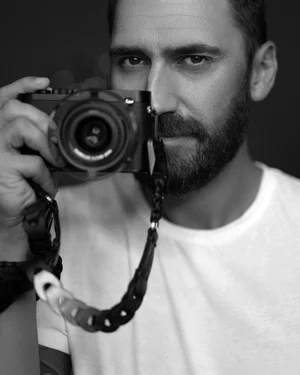
Portrait: Luciano Sandrone
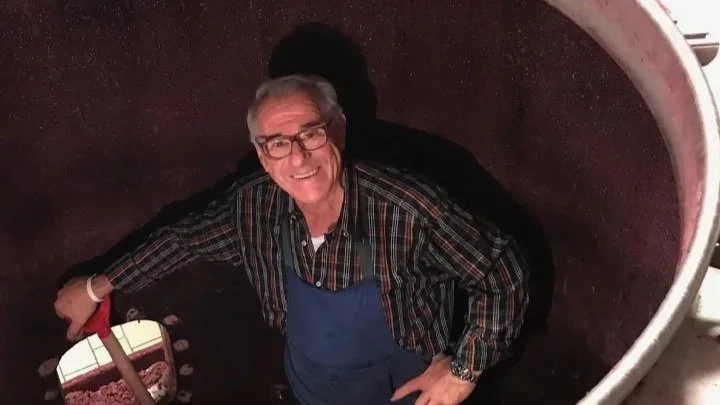
The building is clad in oak. Not decorative oak — used oak, from old barriques, fixed horizontally across the exterior walls in dark, weathered slats. The first time you see it you think you are looking at something that grew here rather than something built. Which is, of course, exactly the point.
I visited on March 17th. Barbara was sick that day. Lucia guided me through instead — patient, precise, clearly someone who has shown hundreds of people around this place and still believes it matters. We walked through the production floor first, then down to the underground cellar for maturation and ageing, then up to the tasting room with its large windows looking out over the valley between La Morra, Barolo, and Castiglione Falletto. Three villages visible from one room. The whole denomination, almost, in a single frame.
Luciano placed this building where it stands on purpose. At the foot of the Cannubi hillside. Looking up at the vines. He built it in 1998, after twenty years of making every vintage in the garage under his parents' house.
I had met Barbara two weeks earlier at Nebbiolo Day in London on March 3rd. A brief conversation in the middle of a long day, presenting the wines to the trade — easy, grounded, the kind of exchange that tells you immediately how a person carries their story. She carries it without performing it. She has been involved in the estate since 1989. This is simply her life.
Luciano died in January 2023. He was 76.
His father was a carpenter in La Morra. That biographical fact is both essential and almost too simple to carry the weight it needs to. Luciano inherited no land, no cellar, no winemaking tradition, no family contacts in the trade. He inherited an allergy to sawdust and a desire to grow things. He graduated from agricultural school in 1973, went to work at Giacomo Borgogno at fifteen, then moved to Marchesi di Barolo, where he eventually became cellar master. The day job gave him a salary. He converted the salary, slowly, into land.
In 1977 he bought a small plot on Cannubi Boschis — a sub-section of the Cannubi hill, south and southeast facing, in a natural bowl that holds the morning warmth longer than the surrounding terrain. The soil is calcareous clay with sand. Good drainage. Even ripening. He spent everything he had on it and had nothing left.
The first vintage was 1978. Made in his parents' garage. 1,500 bottles.
He took them to Vinitaly in 1981 and met an American importer who bought almost every bottle on the spot. That is not luck. That is a decade of invisible preparation meeting one open door.
What Luciano built in the years that followed is one of those stories that embarrasses the phrase self-made because that phrase implies the person came from nothing. Luciano came from patience. From the precise, methodical accumulation of knowledge — first in someone else's cellar, then in his own plot, then in a garage, then in a building he designed himself, positioned where it is so the hill he had been farming on weekends for twenty years was always visible from where he worked.
He refused the Barolo Wars. Both sides offered certainty. Luciano preferred accuracy. He used 500-litre tonneaux — not small barriques, not large botti — because he thought Nebbiolo from Cannubi Boschis needed something between the two extremes. Spontaneous fermentation with indigenous yeasts. Medium maceration. Organic farming. Twelve viticultural staff across 27 hectares. Every decision made around a single question: what does this grape, in this bowl, on this hill, actually need?
In 2013, he renamed the wine. Cannubi Boschis became ALESTE — a combination of his grandchildren's names, Alessia and Stefano. The move confused commentators who expected the opposite: more specificity of place, not less. But Luciano was not making a marketing decision. He was looking at the hill he had farmed for thirty-five years and deciding that the label should carry the names of the people who would carry it forward. A winemaker's last act of confidence.
Nothing in the wine changed. Only the name.
Standing in the tasting room on March 17th, looking out through the large windows at the valley — La Morra to the left, Castiglione Falletto to the right, the Cannubi vines below — I think about what it cost to build a view like this. Not the building. The life. The decades of Saturdays in the vineyard before there was any building at all. The 1,500 bottles in a garage. The American importer who bought them.
Barbara is in London when I visit. Luca is in the cellar. Alessia is alongside him. Stefano is studying in Turin.
The hill is still there. The oak-clad walls are still breathing.
—
Integrity is the refusal to be rushed. // Arnt
Luciano Sandrone was born in 1947 and passed away in January 2023. The estate spans 27 hectares across the Langhe and Roero. The winery is certified organic. Current releases include Barolo ALESTE, Barolo Le Vigne, Barolo Vite Talin, and Valmaggiore Nebbiolo d'Alba. Barbara Sandrone and Luca Sandrone lead the estate today.