The Last Link in the Chain
There is a moment, just before you drink, when nothing has happened yet.
The wine is in the glass. The glass is in your hand. Thirty-eight months of ageing, minimum — that is what the law requires of a Barolo before it leaves the cellar. Then years more in a bottle, if you have the patience. And now, here, the last act: a vessel.
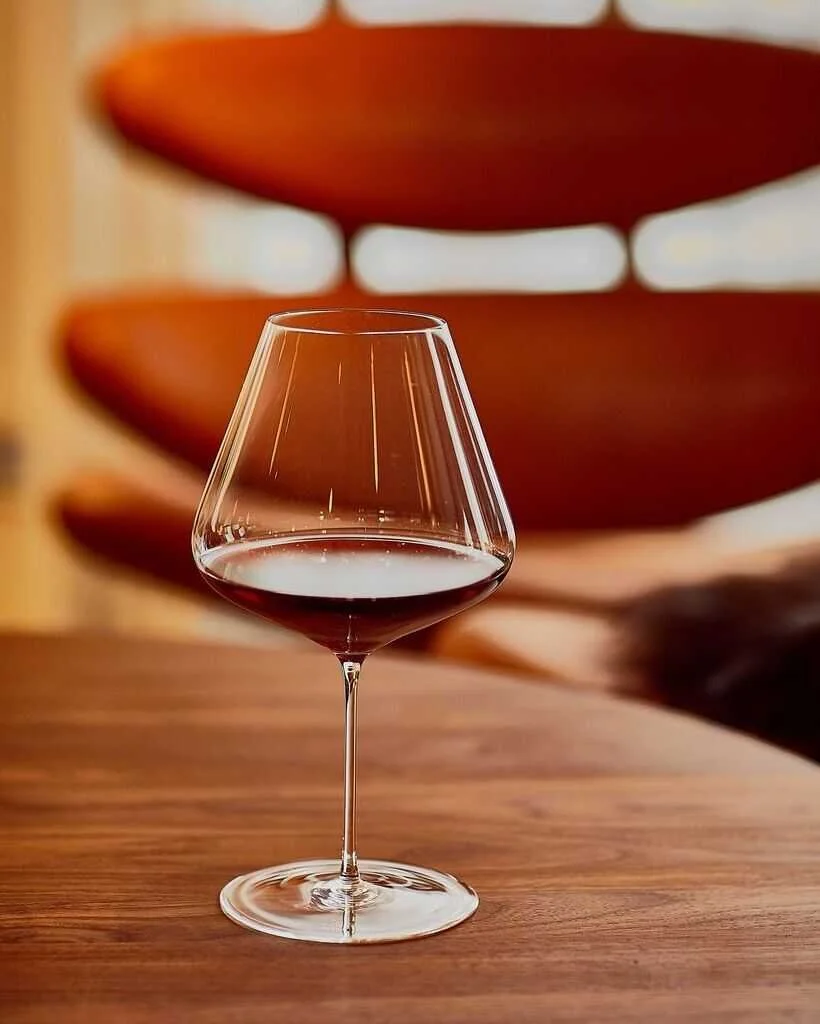
A vignette on the glass that disappears
Most people do not think about the glass. That is precisely the point.
The Zalto Burgundy is the one I reach for with Barolo. It is almost absurdly large. The bowl can hold a full bottle of wine, though you would never pour that much into it. It is light in a way that surprises you the first time — you expect weight, and the glass offers almost none. The stem is barely wider than a matchstick. You hold it like something alive.
The philosophy behind it is simple: the glass should be in the background. The wine is the star. The glass exists to convey the feeling that there is nothing between you and the wine.
That line stopped me when I first read it.
Nothing between you and the wine.
That is not a design specification. That is an ethic.
Kurt Josef Zalto, a sixth-generation glassmaker, spent thirty years pursuing the perfect form. He speaks of "calculated form" — the way the great Renaissance masters did — where every radius, every angle, exists in service of something larger than itself. He made several hundred prototypes before arriving at the shape that now sits on my table.
That kind of patience should sound familiar to anyone who loves Barolo.
The glassblower and the vignaiolo are working toward the same end, from opposite directions. One coaxes something closed into opening. The other builds a vessel precise enough to receive it without interference. Both are in the business of disappearing — making their craft invisible so that something truer can come through.
Each Zalto glass is rooted in four primal elements. Earth, as quartz sand, transformed by fire in the furnace. Air from the glassblower's pipe gives it shape. Water is absorbed into the wooden mould, creating the vapour that gives the glass its surface. The same elements that shape a vineyard. The same patience required to work with forces you do not fully control.
A Zalto does not make a wine taste better. It magnifies a wine's character. It can deliver the finest possible expression — but it can just as easily reveal a wine's faults.
There is no flattery here. No softening of edges. The glass is honest in a way that most things in the wine world are not.
Pour something thin into it, and the glass will tell you. Pour something great — something that has earned its years — and the glass steps aside completely. The Barolo arrives without mediation. The aromatics open in the wide bowl, unhurried. The wine flows across the palate exactly as the winemaker intended, because nothing in the vessel is getting in the way.
This is what real craft does. It serves without announcing itself.
The vignaiolo in the Langhe prunes his vines in winter, alone on a frozen hillside, making decisions that will not matter for years. The nonna rolls her pasta by hand because hands know what machines cannot approximate. The trifolau walks into the dark forest before dawn, trusting the dog, trusting the ground, trusting that what is hidden will eventually be found.
None of them performs their work. They do it, and then they step back.
The Zalto is the same discipline, expressed in crystal. Hundreds of prototypes made by a man who spent thirty years thinking about angles and light and the precise moment a wine meets a mouth — all of it so that the glass itself would not be noticed.
The best hands in any craft are the ones you forget were there.
Integrity is the refusal to be rushed. // Arnt