The Sound of the Label
In the cellar on Via Roma 15, there once was a sound you won't hear anywhere else: the dry whisper of horsehair against glass. Bartolo Mascarello, sitting at a wooden table, painting labels by hand.
Each one was different. Each one took time.
The label didn't describe the wine. It didn't list tasting notes or vineyard coordinates. Instead, it carried whatever image came to him that year—a sun, a political statement, a phrase scrawled across a wall. Some years, it was playful. Other years, it was defiant. Always, it was singular.
The most famous: "No Barrique, No Berlusconi"—a double refusal painted onto bottles during the late 1990s, featuring cutout photos of the prime minister with a paper flap you could pull down "when you get sick of looking at him". It was Bartolo's declaration against two evils he saw threatening his world: the modernization of Barolo through French oak, and a political culture he found morally bankrupt.
This was not branding. It was the opposite.
The Cost of the Signal
In a world where consistency signals professionalism, these labels signaled something else: presence. They said, "I was here. I touched this. I refuse this."
I've spent thirty years in brand strategy, and I know this truth: the difficulty of the act proves the quality of the signal. When something requires genuine effort—effort that cannot be faked or outsourced—it carries a weight no marketing budget can manufacture. Bartolo's hand-painted labels told you he valued conviction over commerce, time over efficiency, craft over scale. It's proof you cannot counterfeit, because counterfeiting it would demand the same devotion as the original.
This is what I call costly signaling. And it's becoming the rarest currency in a world that mistakes automation for progress.
The Anti-Digital Signature
In a market of pixel-perfect logos and algorithmically optimized design, Bartolo's brushstroke was a thumbprint of integrity. It was unscalable by design. You cannot franchise it. You cannot template it. You cannot make it more efficient without destroying what makes it valuable.
This is the ultimate luxury: a product that refuses to be mass-produced, even at the level of its packaging. His original hand-painted labels are now collectors' items, sought after not for their perfection but for their singularity.
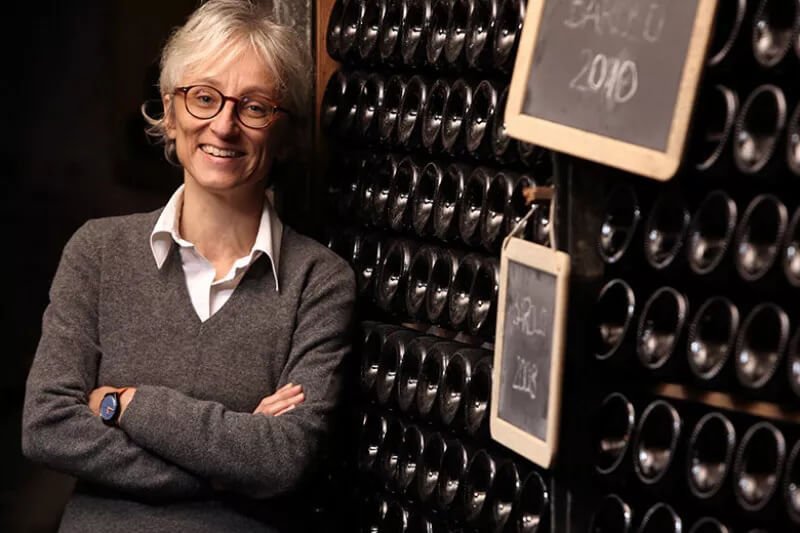
Today, Maria Teresa continues her father's tradition, producing limited "Artist Label" runs using reproductions of Bartolo's original designs. She doesn't paint them herself—that was his voice, his hand, his refusal. But she honors the tradition by keeping his images alive on select vintages, a reminder that some gestures cannot be improved upon, only preserved.
What Silence Teaches
I imagine him in that cellar, the scratch of bristles on glass. The silence between strokes. No music. No conversation. Just the rhythm of someone who knew exactly what he was doing and saw no reason to do it differently.
The label was not decoration. It was an artifact of conviction—the time it took to paint it, the courage it took to declare "No," the patience the wine demanded before it could be opened. Everything about Bartolo Mascarello whispered the same message: Pazienza. Patience. And Coraggio. Courage.
In a world obsessed with slick design and instant recognition, these labels remain radical. They resist photography. They resist replication. They resist the very logic of modern commerce, which demands scalability.
And yet, collectors treasure them. Not despite their imperfection and politics, but because of them.
What if value isn't in what you perfect,
but in what you refuse to automate? // Arnt