The Hill That Has to Be Earned
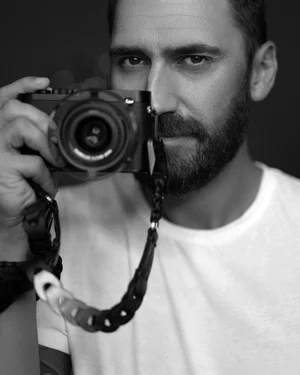
Portrait: Massolino
Franco Massolino's least favourite childhood memory is the hazelnut harvest.
On his knees, in the grass, picking by hand. For hours. His big hands too slow for the work — his sister and aunt always faster, always further ahead in the row. He still talks about it the way people talk about something that shaped them without asking permission.
It is a strange entry point for a man who now tends some of the most celebrated vineyards in Barolo. But it is the honest one. And honesty is where Massolino always begins.
130 Years in One Village
The Massolino family has made wine in Serralunga d'Alba since 1896. The founder, Giovanni, was a determined and creative man — a farmer who was also, improbably, the first person to bring electric current to the village. He wired Serralunga himself. Not because it was his profession. Because he decided it should be done, and did it.
His son Giuseppe built the first cellar beneath the family house and began planting vineyards in the finest plots of Serralunga. In 1934, Giuseppe was among the founders of what is now the Consorzio di Tutela Barolo, Barbaresco, Alba, Langhe e Dogliani — the institution that defines and protects what Barolo legally is. A family that lit the village, then helped build the framework that protects what the village makes.
For the early generations, wine was one part of a mixed farm economy: fruit, vegetables, livestock, bulk wine sold by the barrel to whoever was buying. The Massolino name did not appear on a label. The wine existed, but anonymously — a contribution to someone else's bottle.
The third generation changed that. Renato, Giovanni, and Camilla — Giuseppe's children — drove the estate's expansion through the 1960s, 70s and 80s: building the first dedicated winery, purchasing the crus of Margheria and Parafada, and beginning the long acquisition of Vigna Rionda that would define the estate's identity for generations to come.
The Gamble on Vigna Rionda
Vigna Rionda is not a vineyard you accumulate casually.
The hill sits above Serralunga village on a steep south-facing slope of compact Helvetian limestone — a place of extraordinary concentration and power, shared among a small number of producers who have fought, negotiated, and inherited their way into parcels here over decades. The Massolino family's relationship with it began when Giuseppe inherited some land in the area from his aunt Matilde Ornato, and then made a decision that Franco still describes with something close to reverence.
To acquire a small but precious parcel of Vigna Rionda, Giuseppe had to give up a plot twice the size.
One hectare for half a hectare. Less land, better land. A smaller holding in the right place over a larger holding in the wrong one.
The estate's own history describes it plainly: "Grandfather Giuseppe falls in love with Vigna Rionda and completes the purchase of a small portion of the land. The operation requires an exchange. In order to obtain the plot, Giuseppe has to give up one twice the size. Unquestionably a gamble, but also an act of faith and proof of foresight."
That act of faith set the direction of everything that followed. Over subsequent decades, the family continued acquiring parcels of Vigna Rionda piece by piece — the most important annexation, the final parcel — until their current holding of three hectares within the 10.54-hectare total was complete.
Franco began releasing Vigna Rionda as a single-vineyard wine in 1982.
The Portfolio: Three Voices from One Village
The Massolino approach to their single-vineyard wines reflects a deep understanding of Serralunga's internal geography. They do not make one style and apply it across crus. They listen to what each site is saying and try not to interrupt.
Margheria sits on the lower slopes just below the winery, facing south and south-west towards Monforte d'Alba. Its 1.5 hectares sit on sandier Helvetian soils that drain more freely than the compact limestone of Vigna Rionda, producing a wine of different temperament — more immediately expressive, more floral, the tannins chalkier and lighter in texture. Franco considers it the most elegant of the single-vineyard wines, and the most expressive when young. The bouquet is delicate: rose, violet, a persistent note of orange peel.
Parafada adds another dimension — a wine of depth and savory complexity, the mountain herb and mineral character of Serralunga in a more restrained register.
Vigna Rionda is, in Franco's own words: closed, mute when young. The iron oxide concentrated in the limestone base, a small hill directly in front that blocks the valley winds and holds the warmth a fraction longer than its neighbours — that combination produces something that does not open on your schedule. It opens on its own. You wait, or you miss it.
In 2016, Franco introduced the Etichetta Nera — the Black Label — reserved for vintages that pass a blind tasting against the best Barolos in the market. Not a premium by default. Only when the wine earns it. He references Bruno Giacosa's two-label system as the model: same hill, same grapes, the distinction made by what is in the bottle, not by what the producer decided in advance.
This is rigour as humility. Not every vintage is Black Label. The wine decides.
What the Worst Job Taught Him
The hazelnuts are gone now. The cattle are gone. Sixty hectares of Nebbiolo, a portfolio of single-vineyard Barolos that collectors wait years to acquire, and a son — Luca — who finished his oenology degree last year and is already in the cellar.
When I asked Franco what the most important thing a winemaker can know is, he did not mention extraction rates or fermentation temperatures or oak protocols.
"Speak English perfectly," he said. Then: "But know what the two o'clock sun feels like in the vineyard."
That sentence holds everything. The estate is 130 years old this year. Giovanni lit the village. Giuseppe helped protect the appellation. Franco will not release the Black Label until the wine says so.
The boy on his knees in the hazelnut rows, hands too slow, always behind his sister and aunt — he grew up to become one of the finest custodians of Serralunga's most demanding hill.
The work, it turns out, was always the lesson.
Integrity is the refusal to be rushed.
// Arnt
Azienda Agricola Vigna Rionda S.S.
Piazza Cappellano, 8
12050 Serralunga d’Alba (CN) - Italy
Email: massolino@massolino.it
Instagram: @massolinowinery