The Ceremony of Opening
The Waiter's Corkscrew
He does not make a performance of it.
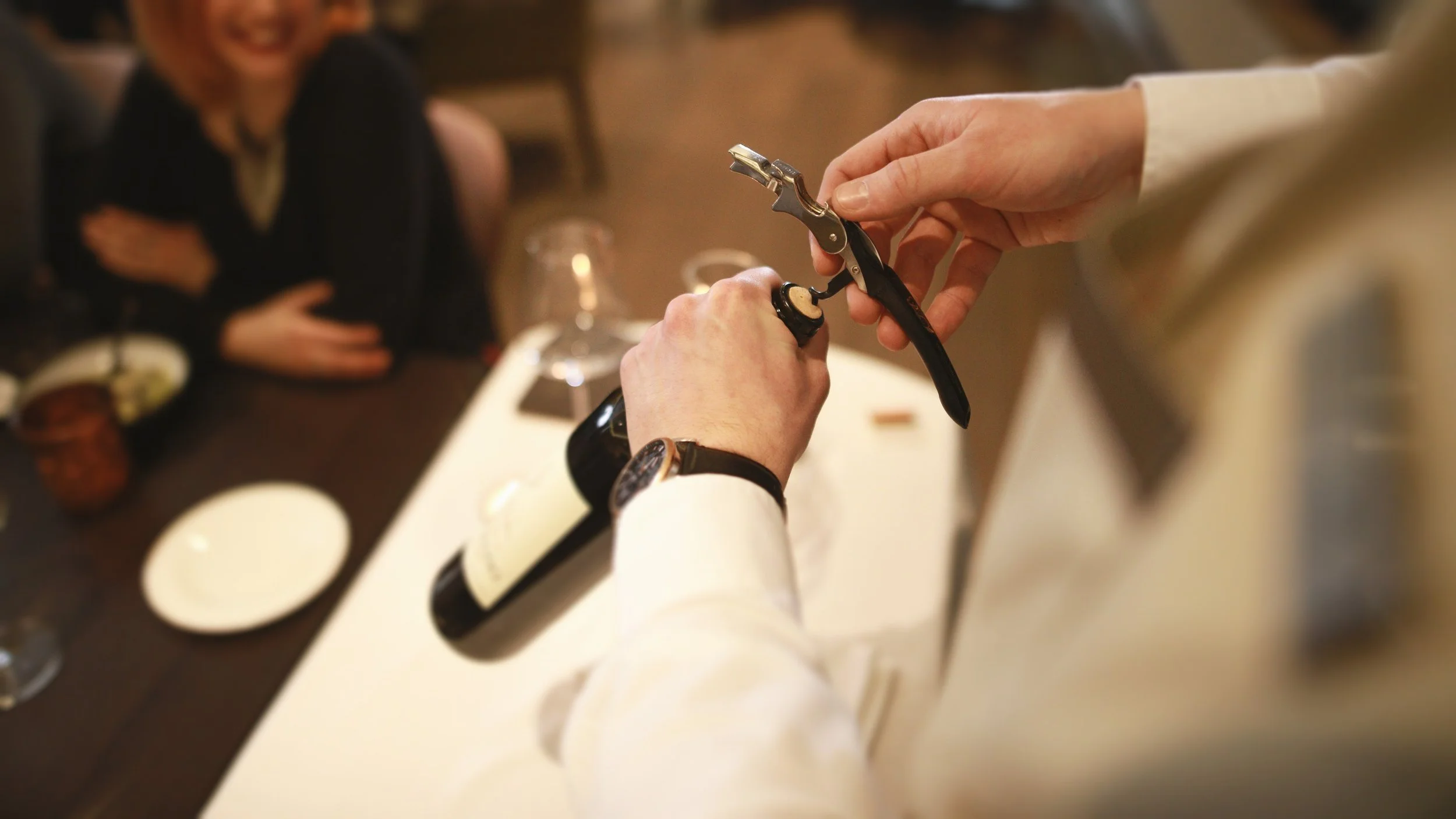
The sommelier in the small trattoria in Barolo arrives at the table with a single waiter's friend—a compact, unassuming tool with a worn wooden handle and a helix that has drawn more corks than he can count. He holds the bottle in one hand. He cuts the foil with a small blade, two clean rotations, a precise lift. The foil comes away in one piece.
No flourish. No pause for the table's admiration.
He positions the corkscrew, turns slowly—five, six, seven rotations—then levers the cork out in two smooth stages. It releases with a soft, low sound. Not a pop. More like a sigh. The bottle has been holding its breath for years, and this is how it finally exhales.
The ceremony takes perhaps forty seconds.
And yet everything about it is deliberate.
We have forgotten how to open things slowly.
In an age where everything is sealed with a cap, zipped with a pull-tab, unlocked with a fingerprint, the act of opening a bottle of wine remains one of the last rituals that cannot be hurried. You cannot force a corkscrew faster than its helix allows. You cannot lever the cork before the screw has found purchase. The bottle imposes its own pace.
This is not inefficiency. This is design.
The cork, compressed into the bottle neck under pressure, has been slowing oxygen exchange for years—allowing the wine to breathe at its own tempo, to evolve without exposure, to become what it becomes only in the dark and the quiet. To remove it is not simply to access the wine. It is to mark the end of one phase of its life and the beginning of another.
The cork is a threshold.
I have opened bottles alone and with twenty people. I have opened them in cellars, at kitchen tables, on hillside terraces in October light. I have opened them with shaking hands after long journeys and with steady hands after long meals.
Each time, the forty seconds ask the same thing of me: slow down.
There is a reason this tool is called a "waiter's friend." The good waiter knows that the ceremony of opening is not for the wine—it is for the people at the table. It creates a pause. A collective orientation. The moment when the conversation shifts from where you have been to where you are about to go.
The cork comes out. Someone leans forward. The bottle is tilted, poured, the first glass offered, swirled, lifted.
For a moment, everyone is paying attention to the same thing.
The Stoics spoke of the transition—the space between one state and another—as a moment of particular clarity. Not the destination, not the origin, but the hinge between them.
The waiter's corkscrew is a hinge.
Between the years the wine spent in the dark and the moment it meets the light. Between the winemaker's intention and the drinker's experience. Between the past that made the bottle possible and the present that finally opens it.
Forty seconds.
Long enough to be grateful for what is about to happen. Short enough that most of us, on most evenings, forget to notice.
The sommelier sets the cork on the table beside the bottle. He does not smell it, does not examine it theatrically. He simply sets it down—a small proof of passage—and pours the first glass.
The ceremony is over. The wine begins.
Pazienza is not waiting for time to pass; it is honouring time's work.
// Arnt