The View from Monforte
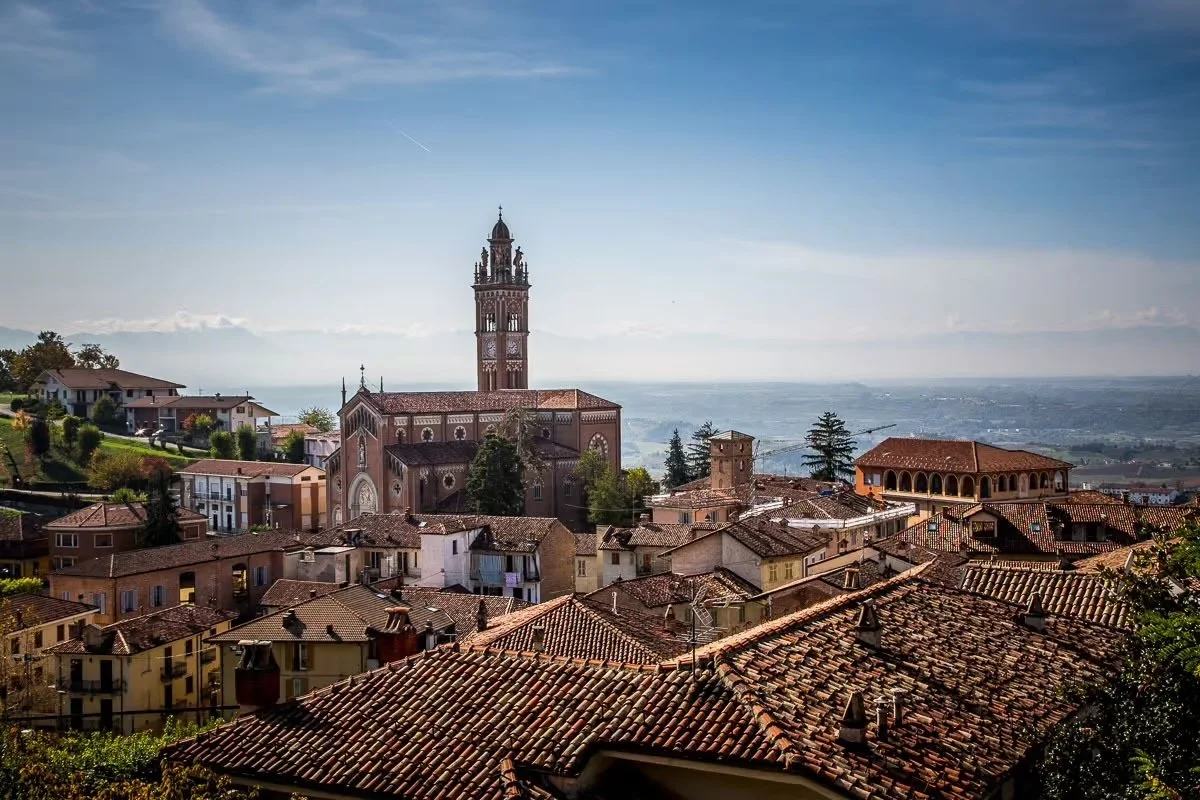
Monforte D’Alba
Monforte d'Alba sits higher than the other communes. You feel this before you can name it — the road tightening as you climb, the light opening in every direction rather than just ahead, the Alps visible to the northwest on a clear morning in a way they are not from the valley floor.
The altitude is not incidental. It is the whole argument.
Monforte is the coolest of the Barolo communes. Longer cold nights, a growing season that extends deeper into autumn, a ripening process slowed by elevation in ways that add complexity, the lower-altitude sites simply do not produce. The soil is primarily Tortonian across much of the commune — the same sandstone and marl that gives La Morra its accessibility and perfume — but here, altitude changes the terms. The vine works longer. The fruit develops more slowly. What emerges carries a structural density that sets Monforte Barolo apart from the wines of the same soil type produced fifty metres lower.
What Monforte produces, in short, is patience. Enforced by geology and weather rather than chosen.
Bussia — the large and heterogeneous MGA that runs below the village toward Castiglione Falletto — is where this is most legible. It is one of the biggest crus in the denomination. Multiple exposures, several distinct soil sub-types within the same mapped boundary, a history of serious production stretching back generations. Fenocchio has farmed their Bussia parcel since 1867. Aldo Conterno, in the Romirasco sub-section, produced some of the most celebrated Barolos the denomination has ever made. The two estates are a short walk from each other. The wines they make from parcels within the same MGA are different in every meaningful way — one austere and slow-building, one more generous and structured — because the cru is large enough to contain multiple conversations simultaneously.
The MGA system exists partly to make this legible to the outside world. Bussia on a label no longer means simply Monforte. It means a specific exposure within a large cru, which begins to approximate — though never quite reaches — the level of specificity that a Burgundian village appellation provides. Whether the drinker follows this notation is another matter. The label points at something the vineyard has always known.
Standing at the edge of Monforte in early spring, before the leaves have come, the Bussia rows run down the hill in parallel lines of dark wood against pale soil. The rows go further than you expect. The cru is generous with its space even if the wines it produces are not generous with their time.
The silence here is particular. Not the silence of emptiness but the silence of altitude — the quality of air at 400 metres above sea level, above the fog that sometimes fills the valley below, above the road noise and the tractor sound, where the wind comes down from the mountains to the north and moves through the bare vine rows without obstruction. Claudio Fenocchio said something in that cellar under the yellow house that has stayed with me: that the technique is not the variable, the place is the variable. Standing above Bussia in that particular silence, looking at the rows that have been in his family for 160 years, the phrase is not abstract. The place is exactly the variable. The place is almost the entire point.
Monforte asks more than the communes to the west. More time in the cellar. More patience at the table. More willingness to wait for what the altitude built slowly over a long growing season to reveal itself without being forced.
From up here, the valley below is often hidden by fog in the morning. The hill sits in clean air above the cloud.
What grows in that air is in no hurry.
Patience, here, is not a virtue.
It is a geography.
The most important things in life are sensed, not seen. // Arnt